
75th Anniversary of Civil Rights Congress Petition
Podcast (the-green-blues-show): Play in new window | Download
Subscribe: RSS
“The Crime of Government Against Negro People”
In the summer of 1944, when Nazi death camps were known to exist, but the total number of their victims had yet to be tabulated, a Polish Jew named Rafael Lemkin came up with a word for the crime Hitler and his henchmen were committing.
Genocide — the ‘crime of crimes’ — couldn’t have been a more appropriate international legal issue for the international community’s newly minted governing assembly to pronounce on, three years after its founding.
On December 8, 1948, the Convention on the Prevention and Punishment of the Crime of Genocide was adopted by unanimous vote at the UN General Assembly.
Under the Convention, genocide was defined as one or another of various acts, “committed with the intent to destroy, in whole or in part, a national, ethnical, racial or religious group, as such.”
Genocidal acts included killing or causing “serious bodily or mental harm” to members of the group,” “deliberately inflicting on the group conditions of life calculated to bring about [the group’s] destruction in whole or in part,” imposing measures “intended to prevent births within the group,” and “forcibly transferring children of the group to another group.”
Donate with a $15/monthly subscription
On the third anniversary of the Genocide Convention’s adoption — eleven months after it came into force; December 17, 1951, to be precise — a pair of African-American activists staged a provocative act.
Singer-actor Paul Robeson and Civil Rights Congress (CRC) leader William Patterson delivered a petition to the United Nations, charging the United States with genocide.
We Charge Genocide: The Crime of Government Against the Negro People bore the names of a hundred American intellectuals and activists.
Barely two months after the start of UN operations in Manhattan, Robeson strolled into the UN’s monolithic Secretariat at First Avenue and East 42nd street, made his way to an upper floor, down the hall, and into an office, where he handed a copy of the petition to a white haired, white-mustached UN official.
An official photo captured the handover, in front of a window looking out on the East River, the We Charge Genocide volume fully framed in river flow. Robson smiles broadly.
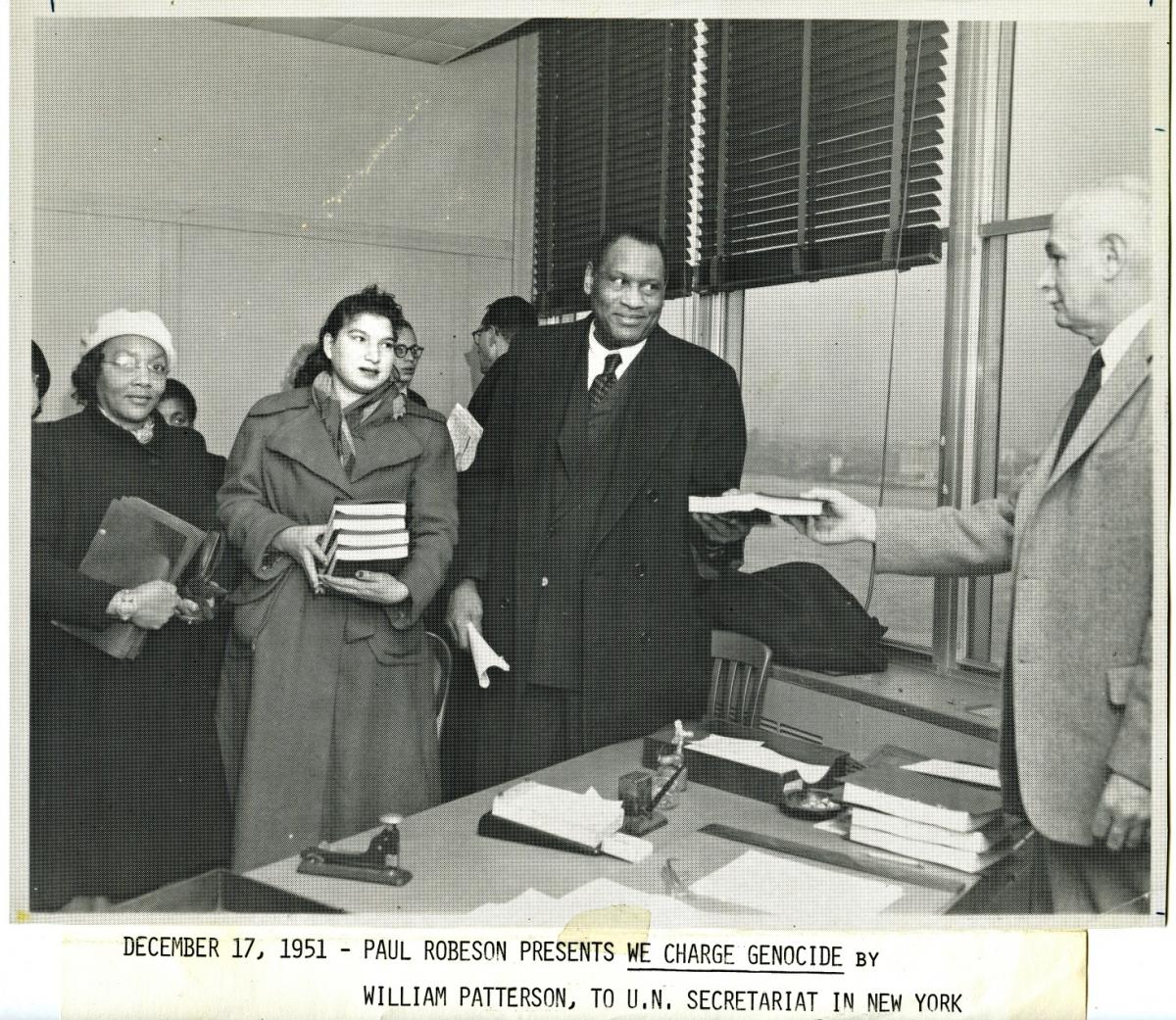
Unapologetically, pro-Soviet, Paul Robson had had his passport seized at this point.
But he believed in himself. Beside him, a pair of women cradled additional copies of the petition in their hands — not much larger than an ordinary soft-covered book, a half-inch thick.
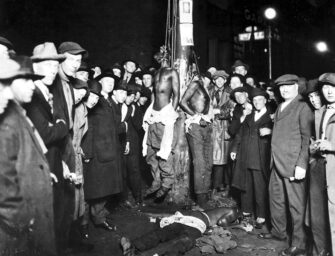
Two pages in from the top, the reader encounters a full-page photo of two young black men hanging from a tree. Dooley Morton and Bert Moore were lynched in Columbus, Missouri, the caption on the follow page explained.
“Such horrifying violence is only one of the many crimes against the Negro people of the United States which together form the major crime of genocide,” the caption reads.
Donate with a $15/monthly subscription
America’s international governing institution now in full operation, presentation of We Charge Genocide to it, in such a sensational way, was the sort of act US authorities frowned on.
As Robeson handed the petition over in NYC, on the other side of the Atlantic, CRC leader William Patterson presented it at a UN meeting in Paris. US authorities promptly seized Patterson’s passport.
Prominent writer W.E.B DuBois, one of 93 “Petitioners” in the tract, had planned to accompany Patterson to Paris, but U.S. authorities blocked his departure.
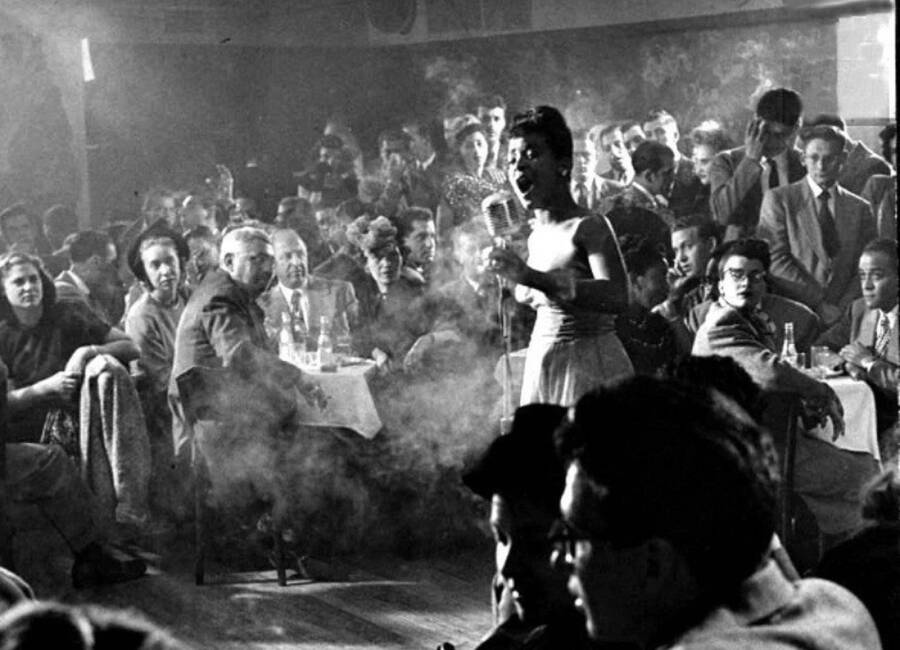
Billy Holiday at Cafe Society
We Charge Genocide was not the first public call for justice for American blacks.
Billy Holiday sang Strange Fruit for the first time in 1939.
In 1946, a 15-page Petition to the United Nations on behalf of 13 million oppressed Negro citizens of the United States of America was submitted to the UN by the National Negro Congress.
The National Association of Coloured People followed suit in November 1947, tabling a 99-page Appeal to The World: A Statement on the Denial of Human Rights to Minorities in the Case of Negro Descent in the United States of America and an Appeal to the United Nations for Redress.
We Charge Genocide upped the ante: 240 pages-worth of factual detail; naming Black American men and women humiliated, oppressed and killed by white American racists.
Part I, “The Opening Statement,” placed the contemporary situation American Negroes face in broader context, framing run-of-the-mill racist treatment within the deeper context of slavery and Jim Crow; in the American system itself, passed down from the Founding Fathers.
In Part II, We Charge Genocide made the legal argument for charging America with genocide.
Having reviewed history, law and the indictment, Part III, “The Evidence,” laid out hundreds of brief thumbnails describing the humiliating, cruel and deadly acts American Negroes face every day, in colourful and graphic fashion.
“Seldom in human annals has so iniquitous a conspiracy been so gilded with the trappings of respectability. Seldom has mass murder on the score of “race” been so sanctified by law, so justified by those who demand free elections abroad even as they kill their fellow citizens who demand free elections at home. Never have so many individuals been so ruthlessly destroyed amid so many tributes to the sacredness of the individual. The distinctive trait of this genocide is a cant that mouths aphorisms of Anglo-Saxon jurisprudence even as it kills … the proof is in every day’s newspapers, in everyone’s sight and hearing in these United States. In one form or another, it’s been practiced for more then three hundred years.”
The lives of America’s fifteen million black Americans were eight years shorter, on average, the petition declared.
“They are forced by threat of violence and imprisonment into inferior, segregated accommodations, into jim crow busses, jim crow trains, jim crow hospitals, jim crow schools, jim crow theaters, jim crow restaurants, jim crowing housing, and finally into jim cow cemeteries.”
America’s genocidal aim, the We Charge Genocide petition proposed — extrapolating from the formal definition: “perpetuation of economic and political power by the few through the destruction of political protest by the many. Its method is to demoralize and divide an entire nation; its end is to increase the profits and unchallenged control by a reactionary clique.”
“Neither Hitler nor Goebbels wrote obscurantist racial incitements more voluminously or viciously than do their American counterparts, nor did such incitements circulate in Nazi mails any more freely than they did in the mails of the United States,” the petition declared, most provocatively.
“[The] killing of Negroes has become police policy in the United States … the most practical expression of government policy.”
Donate with a $15/monthly subscription
Analysis was bound to raise hackles — arguably its intention.
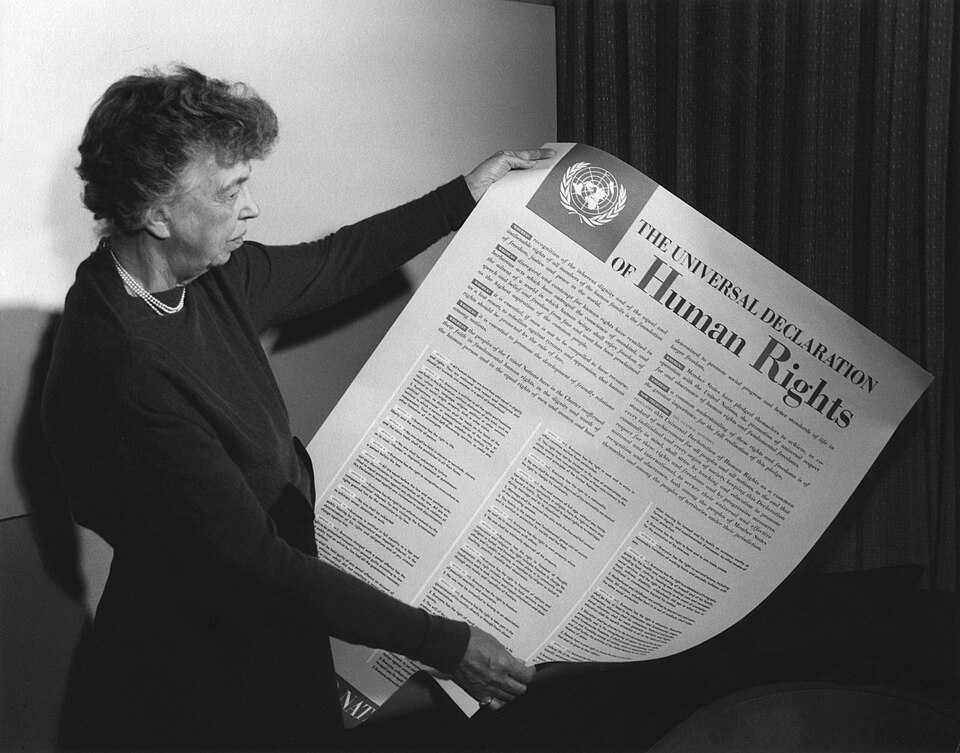
Eleanor Roosevelt
Eleanor Roosevelt, prime author of the Universal Declaration on Human Rights, promulgated by the UN the day after the Genocide Convention, disparaged the We Charge Genocide petition. She had refused to present earlier petitions to the UN Commission on Human Rights.
Predictably, mainstream media excoriated We Charge Genocide in their back-pages.
“Shameful lies,” the Chicago Tribune called it.
In an 80-word dispatch about CRC Secretary William Patterson’s presentation in Paris, on December 18, 1951, the New York Times framed the word genocide in quotes. According to the newspaper of record, Raphael Lemkin, the Yale University professor who coined the term genocide, had “assailed” the petition [the Times’ verb].
We Charge Genocide author, the Civil Rights Congress, “is listed on the Attorney General’s list as subversive and Communist-controlled,” the Times informed its readers. And (without quotes in its original report): “Dr. Lemkin said [CRC] accusations were a maneuver to divert attention from the crimes of genocide committed against Estonians, Latvians, Poles and other Soviet-subjugated peoples.”
‘Negros’ in America were victims of racism and discrimination, Lemkin insisted, not genocide, the Times reported.
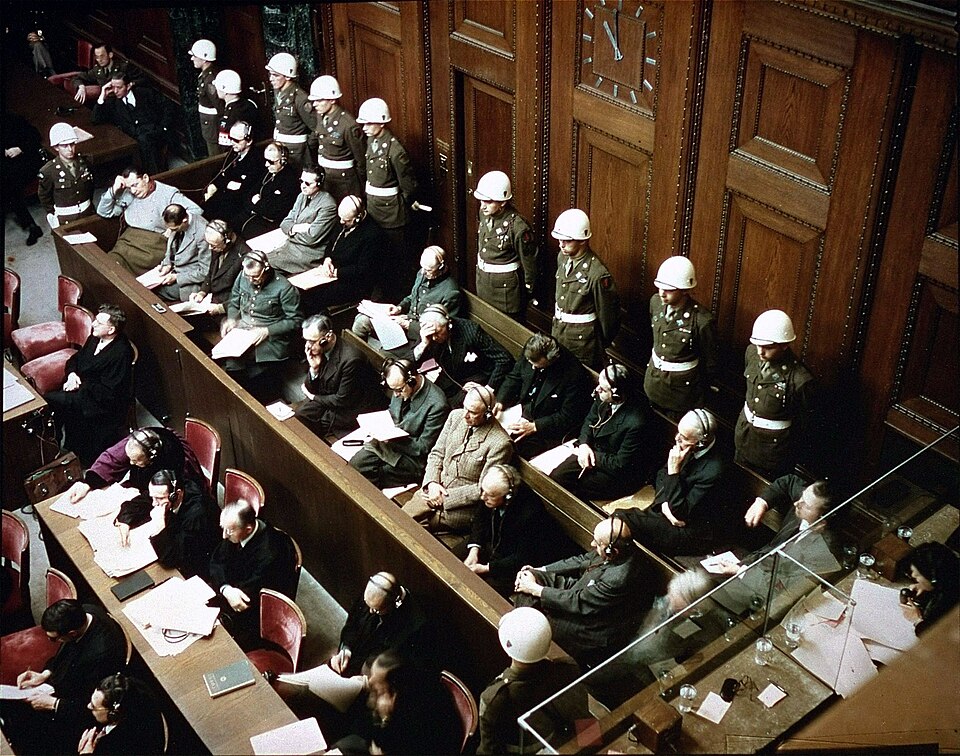
Defendants in dock at Nuremberg
As for the Truman Administration, the Missouri haberdasher and his advisers publicly opposed the crime of genocide. Having conceived and organized the Nuremberg and Tokyo trials, between November 1945 and October 1946, America’s commitment to abolishing crimes of the sort Germans and Japanese was unquestionable — crimes committed by other countries and their nationals, not by Americans like Curtis LeMay.
So, the US happily placed its signature on the Geneva Convention.
“I am privileged to sign this Convention on behalf of my Government, which has been proud to take an active part in the effort of the United Nations to bring this Convention into being,” said US Envoy Extraordinary and Minister Plenipotentiary of the US to Switzerland, John Carter Vincent, two days after most of the rest of UN members signed.
“The Government of the United States considers this an event of great importance in the development of international law and of cooperation among States for the purpose of eliminating practices offensive to all civilized mankind,” Carter Vincent added.
Of course, in the course of their review of early drafts, US diplomats had made sure the Genocide Convention complied with American interests, without mortgaging an ounce of American sovereignty.
State Parties would need to ratify the Convention in order for it to come into effect (The US Senate would take forty years to do this, adding to limitations and exclusions set forth in December 1948 in doing so). Signatories to the Convention would be responsible for trying their own citizens. Should an international criminal tribunal ever be established, it could try individuals for genocide — provided that person’s state accepted the court’s jurisdiction.
And, alleged genocidal acts would not “be considered political crimes for the purpose of extradition” (thereby shielding Americans), and states could renounce the Convention, with six months notice.
Donate with a $15/monthly subscription
Having secured national safeguards against genocide charges, American diplomats responded poorly to We Charge Genocide. On top of it all, the petition’s most prominent author, Paul Robeson, was an avowed communist.
The GPM spoke with Alexander Hinton about the We Charge Genocide petition, 75 years after its submission to the UN. Hinton is Distinguished Professor of Anthropology at Rutgers University, Director of its Center for Study of Genocide and Human Rights, and UNESCO Chair on Genocide Prevention.
Listen to our conversation in today’s podcast. Click on the play button above, or go here.
Watch our complete conversation here:


Latest Comments
[…] US military nuclear testing site. At the time, residents were relocated to nearby Rongerik and Kwajalein atolls before arriving at Kili Island in […]