
ClimateWatch - Episode One ... Origins
Podcast (the-green-blues-show): Play in new window | Download
Subscribe: RSS
Twenty-Five Years Later, Situation Much Worse
David Kattenburg
The death toll in flash flooding along the Nepal-Tibet-Chinese border — triggered by the collapse of a Himalayan glacier, and ensuing tsunami of water, mud and rock — has now topped 1300.
Over 4400 are missing, including 500 foreign pilgrims and trekkers from India, the UK, US, Australia and Canada.
The Langtang Girung glacier’s collapse set off vibrations detected by seismologists around the world, pegged at between 4.4 to 5.2 on the Richter scale, bursting the banks of the Trishuli, also known as the Bhotekoshi, and the Lhende Khola, on the tri-border region of Nepal, Tibet and China.
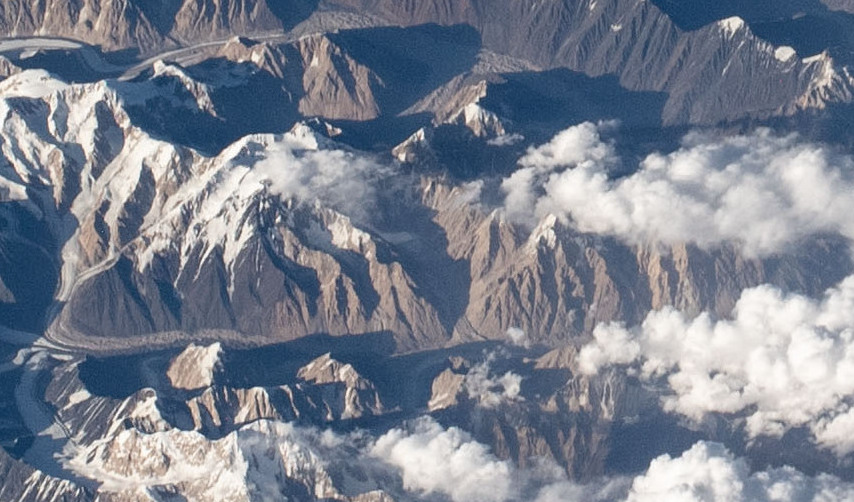
Hindu Kush (NASA)
Climate scientists are cautious. The breakdown of Earth’s climate system — now well underway — can’t be categorically blamed for this one event, they say. But killer floods triggered by the gradual warming and collapse of massive glaciers, in high elevation spots where Earth’s cryosphere hangs on for dear life, is precisely what one would expect to arise when you heat up the planet’s surface.
The upper high Himalayas are warming at twice the average global rate.
Since the year 2000, the rate of glacier melting in the Hindu Kush region of the Himalayas has doubled.
Donate with a $15/monthly subscription
The collapse of the Langtang Girung glacier, and the deadly flooding it triggered, is one more indication that climate breakdown is upon us.
Over 35,000 “excess deaths” are tied to this past summer’s heat wave across Europe; wildfires in Canada, the northwest US, France and Spain spawned pyrocumulonimbus clouds, altering regional climate.
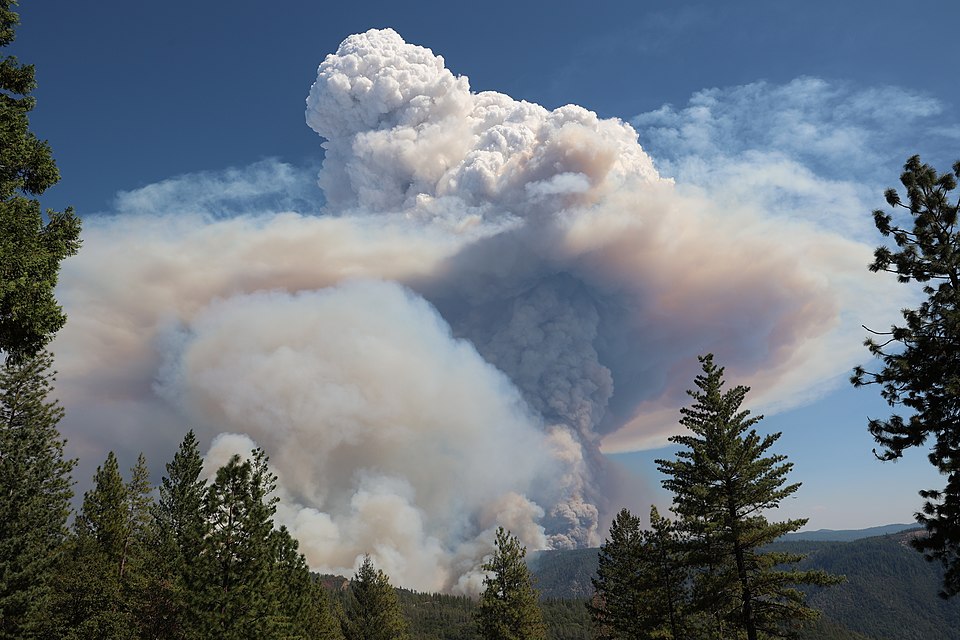
Mosquito Fire producing pyrocumulonimbus cloud, 2022
Back in 2001, I produced a series of four documentaries about Earth Climate, climate change, and the future of human society. ClimateWatch, it was called. Since then, our understanding and appreciation of the climate situation has increased enormously.
At the time Climate Watch was produced, the UN-mandated Intergovernmental Panel on Climate Change (IPCC) was about to release its Third Assessment Report on the state of Earth’s climate.
Twenty-two years later, in March 2023, the Final Synthesis of the IPCC’s Sixth Report declared that mean Earth surface temperature was likely to exceed 1.5 °C under higher emission scenarios, relative to preindustrial values.
Anthropogenic greenhouse gases (especially CO2, methane and nitrous oxide) and human land use, the report said, had unequivocally caused global warming, with global surface temperature reaching 1.1°C in 2011–2020, relative to 1850–1900.
At the time of the IPCC’s Sixth Assessment, atmospheric CO2 concentration had exceeded 400 ppm.
The IPCC’s Seventh Assessment report, due to be released in 2029, will report even higher concentrations.
According to the National Oceanic & Atmospheric Administration, in July of this year, atmospheric CO2 concentration topped 429 ppm.
In keeping with the laws of physics, mean Earth surface temperature has kept track with the concentration of atmospheric CO2 (and other atmospheric green gases), rising in tandem.
The steady rise in atmospheric CO2 concentration since 1958 is clearly evident in the Keeling Curve, developed by Charles David Keeling, based on measurements at Mauna Loa Observatory, in Hawaii.
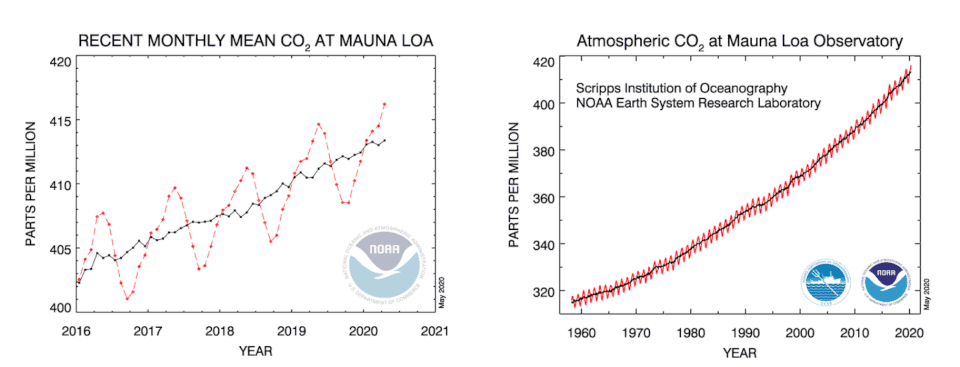
Keeling Curve
Mean sea level is rising too, pegged to climb up to three-quarters of a meter by 2100 under intermediate scenarios, flooding densely populated coastlines around the planet.
So, here’s the first in the ClimateWatch series – Origins — about the determinants of Earth’s climate, and climate system drivers. It is narrationless. People introduce themselves. They’re all still around.
Listen to Origins in today’s podcast. Click on the play button above, or go here.
Donate with a $15/monthly subscription
As best as we can determine (please fill us in if we’re wrong), Ed Carmack, Ken Denman, Humfrey Melling, and David Fisher are busy doing science, some in retirement some not. (No one ever retires from this stuff).
Jay Malcolm is active, and John Fyfe too.
Back in 2007, John Fyfe shared the Nobel Peace Prize for helping to found the IPCC.
Gordon McBean is Chairman of the board of trustees of the Canadian Foundation for Climate and Atmospheric Sciences.
Andrew Weaver led the British Columbia Green Party from 2015 to 2020. Since then, he’s stuck to climate modelling.
Henry Hengeveld‘s activities are uncertain.
Roy (Fritz) Koerner passed away in 2008.
Professor C.S. Wong passed away in 2013, still active. Chi Sing Wong, Charles David Keeling’s first graduate student, was an illustrious geochemist, specializing in the complex chemistry of Earth’s oceans.


Latest Comments
[…] US military nuclear testing site. At the time, residents were relocated to nearby Rongerik and Kwajalein atolls before arriving at Kili Island in […]