
Frozen solid -- Warming, Expanding, Polluted & Acidified
Podcast (the-green-blues-show): Play in new window | Download
Subscribe: RSS
Snowball Earth
Long before the explosion of multicellular life in Earth’s oceans, a half billion years ago, those oceans were covered in ice hundreds of meters thick.
Beneath that ice, darkness reigned, and photosynthetic organisms fell silent (there were no animals back then).
Snowball Earth, is how geologists describe the planet back then. Joe Kirschvink, a geophysicist at the California Institute of Technology, pioneered the concept in the early 1990s.
Viewed from the moon during the Cryogenian and early Ediacaran periods of the Neoproterozoic Era of Earth time, between about 720 and 640 million years ago, Earth would have glistened like a snowball.
Donate with a $15/monthly subscription
Two pan-planetary glaciation events have been documented — the Sturtian, between about 720 and 660 million years ago (mya), and the Marinoan, between about 645 and 640 mya.

Take a close look at the top right of this chart
Last week, the Canadian geologist who popularized Joe Kirschvink’s idea, helping to overcome widespread skepticism, gave a talk at McMaster University, in Hamilton, Ontario.
Having earned a geology degree from McMaster University in 1964, Paul Hoffman worked for the Geological Survey of Canada for a while, studying Proterozoic geology across Canada’s north, then moved on to the School of Earth and Ocean Sciences, at the University of Victoria.
Hoffman is now Sturgis Hooper Professor Emeritus of Geology at Harvard University.
I interviewed Paul Hoffman back in the early 1990s, for my Earth Chronicles series.
At the time, Proterozoic carbonates and the involvement of plate tectonics in Earth’s early history were his areas of specialty. Hoffman was aware of Joe Kirschvink’s Snowball Earth idea, but never dug down into the details.
In the course of geology fieldwork in northern Namibia, studying the relative proportion of carbon isotopes in sedimentary rock, his interest grew enormously.
When I heard Paul Hoffman would be giving a talk at Mac about Snowball Earth, I registered.
Hoffman’s mid-June presentation to a roomful of Mac grads — reviewing evidence for Snowball Earth from the fields of geochemistry, paleoclimatology, biology, and molecular phylogeny; outlining how life may have radiated from that exceptionally chilling experience (“the early Ediacaran fossil record (635-575 Ma) is understudied outside China”) — was both engaging and intellectually challenging.
Afterward, Hoffman accompanied me to the studios of CFMU, where we sat down for a talk about Snowball Earth.
Listen to our conversation in today’s podcast. Click on the play button above, or go here.
Donate with a $15/monthly subscription
Listen to our complete conversation here:
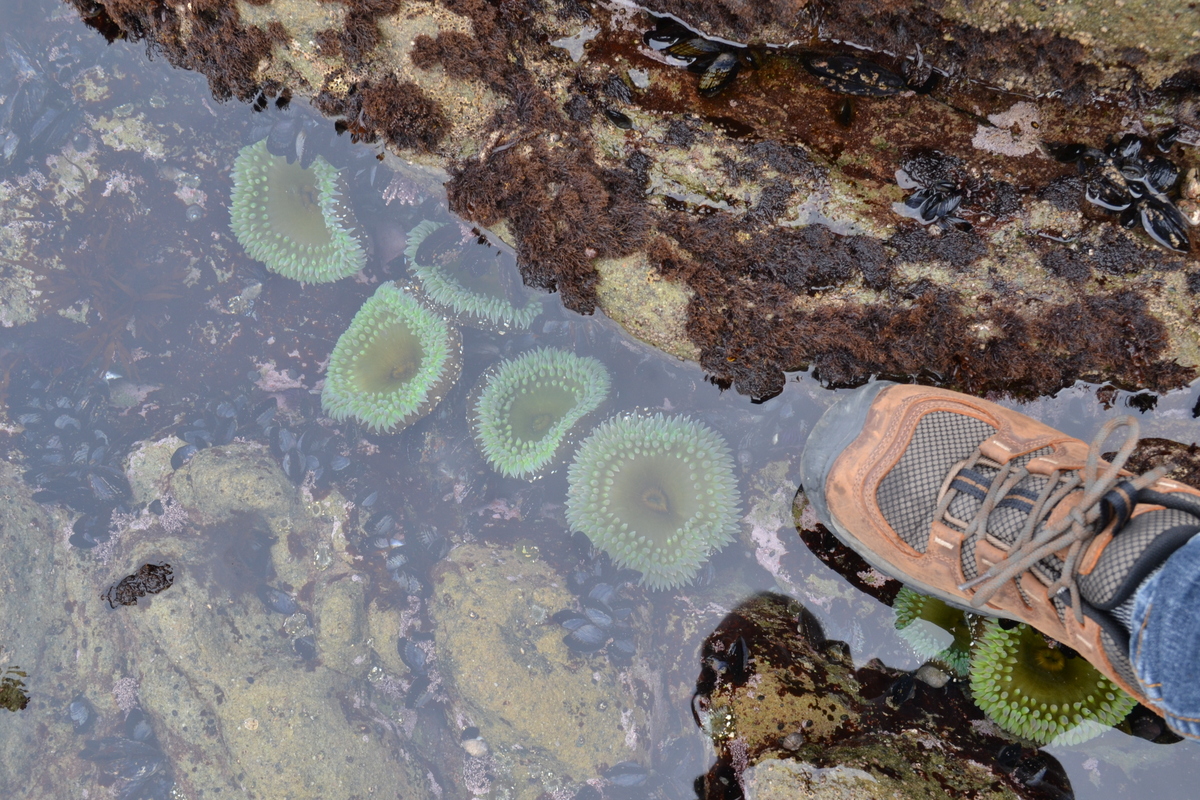
California tide pool (David Kattenburg)
Then there’s the status of Earth’s oceans today. Largely liquid, they’re in a worrisome state.
Seventy percent of Earth’s surface is covered in ocean.
Currently pegged at 8.4 billion – and growing – human populations have wreaked havoc on them, contaminating them with chemical substances of all sorts, monumental volumes of plastic, and megatons of terrestrial sediment.
A third of the CO2 humans have pumped into the atmosphere over the course of the last 200 years, burning fossil fuels, has ended up in the oceans, acidifying them. Acidification pushes ocean carbonate chemistry out of long-established equilibrium, disrupting the ability of shell-forming plankton — the base of marine trophic chains — to build their shells.
At the same time, ninety percent of anthropogenic, CO2-generated atmospheric heat has been absorbed by Earth’s oceans, both heating and expanding them. The rate of sea level rise has reportedly doubled over the past fifty years, threatening coastal communities around the world. Over a third of humanity lives within a hundred kilometers of the coast, mere meters above the ocean’s fast rising surface.
Alongside changes in the physical structure and chemistry of Earth’s oceans, the animals and plants that call them home are taking a hammering.
Impacts on coastal salt marshes, seagrass meadows, mangrove forests, and coral reefs — among the most productive, carbon-storing ecosystems on Earth — and on iconic marine mammals in both coastal and pelagic zones, are easy to observe.
Much less easy to monitor are the extraordinary communities of free-floating plant and animal plankton, and soft-bodied benthic (bottom-dwelling) organisms inhabiting the depths of Earth’s open oceans, especially along submarine ridges and seamounts, on abyssal plains, and at the bottom of incomprehensibly deep trenches.
Research continues to highlight the extraordinary lives of creatures few if any humans have ever observed. Their ability to thrive, unbeknownst to humans, is astonishing.
Donate with a $15/monthly subscription
If Earth’s ocean creatures are in trouble, so are humans. But ocean experts are hopeful. Oceans need to be managed more effectively. The GPM spoke about this with Rafael Gonzalez-Quiros, joint coordinator of a group of ocean experts, and co-author of the UN-affiliated Third World Ocean Assessment.
Listen to our conversation in today’s podcast. Click on the play button above, or go here.
Listen to our complete conversation with Rafael Gonzalez-Quiros here:
Donate with a $15/monthly subscription



Latest Comments
[…] US military nuclear testing site. At the time, residents were relocated to nearby Rongerik and Kwajalein atolls before arriving at Kili Island in […]