
Truth Angers Winnipeg Zionists
Podcast (the-green-blues-show): Play in new window | Download
Subscribe: RSS
“How does one measure the success of a museum?” American fossil fuel magnate John Paul Getty purportedly asked.
Getty’s answer: Successful museums “collect, preserve, interpret, and display objects of cultural, historical, or scientific significance,” thereby “facilitating education through exhibitions and programs aligned with academic curricula.”
Museums are homes for “dead gods,” American essayist H.L. Mencken wrote, in characteristically trenchant fashion.
In fact, the most successful museums are homes for the living — stoking outrage, protests, and boycotts, on the one hand, and curious visitors on the other.
In the early twentieth century, the International Exhibition of Modern Art drew both condemnation — for blurring true art and obscenity — and huge crowds.
Countless other museum exhibits across North America and Europe have been condemned for whitewashing racism, plundering or appropriating indigenous artifacts, promoting communism, diminishing the horrors of the Holocaust, or questioning the righteousness of the atomic bombing of Hiroshima and Nagasaki.
This past summer, an exhibit at the Canadian Museum for Human Rights, in Winnipeg, stoked furor among Canadian Zionists.
Palestine Uprooted: Nakba Past and Present, the exhibit is called. It’s scheduled to run until late November 2028.
In the museum’s own words, the exhibit “explores the human rights violations related to the ongoing forced displacement and dispossession of Palestinians … For many, this uprooting is not a closed chapter of history. It is an experience that endures, shaped by wars, military occupation and violations of human rights across five generations.”
Predictably, major Canadian Zionist organizations were outraged (check out this and this).
In Winnipeg, a very Zionist town, anger among Israel-lovers is palpable.
The Nakba’s curation was wholly ahistorical, and they hadn’t been consulted, so the exhibit should be scuttled, Canadian Zionists say. Jews are the Land of Israel’s ancient ancestral people, they declare – not Palestinians.
If ‘Arabs’ were uprooted in the course of Israel’s founding, Zionists claim, they left of their own accord, encouraged by Jew-hating Arab leaders intent on completing Hitler’s work.
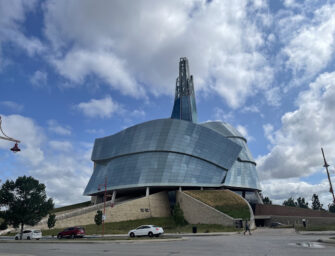
Winnipeg’s Museum for Human Rights is no stranger to controversy. Founded as a Crown Corporation — the first national museum to be established outside the nation’s capital — the museum was already the subject of debate when it opened its doors in September 2014. It stood on indigenous land, First Nations leaders pointed out, on Treaty One territory, and the heartland of the Métis people.
In response to the museum’s first two ‘permanent’ exhibits, focusing on the Holocaust and Holodomor, advocates for other human rights causes groused that their own issues had been ignored.
As Zionists are wont to do, Canadian ones turned the controversy inside-out and upside down. How their cherished ‘Jewish’ state was founded was more than just their issue; the issue was being curated in their museum.
Indeed, the idea of building a museum of human rights in Winnipeg was the brainchild of media mogul, Liberal Party insider, philanthropist, and staunch Winnipeg Zionist Israel (Izzy) Asper.
Under Asper’s guidance, notable museum experts conducted a feasibility study. A charitable organization was struck, the Friends of the Canadian Museum for Human Rights, to finance the museum’s construction.
Izzy Asper didn’t live to see the human rights monument he helped create — an astonishing mountain of steel, rock and glass at Winnipeg’s famous Forks, between the Red River and Israel Asper Way, designed by American architect Antoine Predock. But the Asper Foundation continues to carry Izzy’s torch.
Following the opening of the Nakba exhibit, in late June, the Asper Foundation announced that a $50,000 donation to the museum would be paused. Elements of the exhibit were compelling, foundation trustee Gail Asper allowed, but greater Jewish dispossession and suffering had been ignored. Worst of all, Jewish Canadians hadn’t been consulted by the Nakba exhibit’s curators.
Among the elements in the Winnipeg exhibit that irritate Zionists and their anti-Palestinian supporters in Canada’s right wing media: a traditional Palestinian tatreez embroidery visitors can touch, activating a film about the forced expulsion of the Palestinian people by European settler-colonists; a set of keys to a family home in the Palestinian village of Umm Khalid, now Netanya, in Israel; an installation entitled Curfews and Closures, consisting of a keffiyeh wrapped around a body, inside a metal cage; a painting entitled Bound Together in Gaza, reminiscent of Pablo Picasso’s Guernica, accompanied by lines from Palestinian poet-laureate Mahmoud Darwish.
The GPM spoke about the Palestine Uprooted: Nakba Past & Present exhibit with Isha Khan, CEO of the Canadian Museum for Human Rights.
Listen to our conversation in today’s podcast. Click on the play button above, or go here.
Watch our complete conversation here:

Latest Comments
[…] US military nuclear testing site. At the time, residents were relocated to nearby Rongerik and Kwajalein atolls before arriving at Kili Island in […]